Class
Re: Topic 24.12.2025
здравствуйте
Re: Topic 24.12.2025
от Малик Албарадан -
Здравствуйте
Re: Topic 24.12.2025
от Анасс Эль Фатими -
Re: Topic 24.12.2025
от Арам Азиб -
Здравствуйте
Re: Topic 24.12.2025
от Пелинсу Кара -
Здравствуйте
Re: Topic 24.12.2025
от Арам Азиб -
Re: Topic 24.12.2025
от Малик Албарадан -
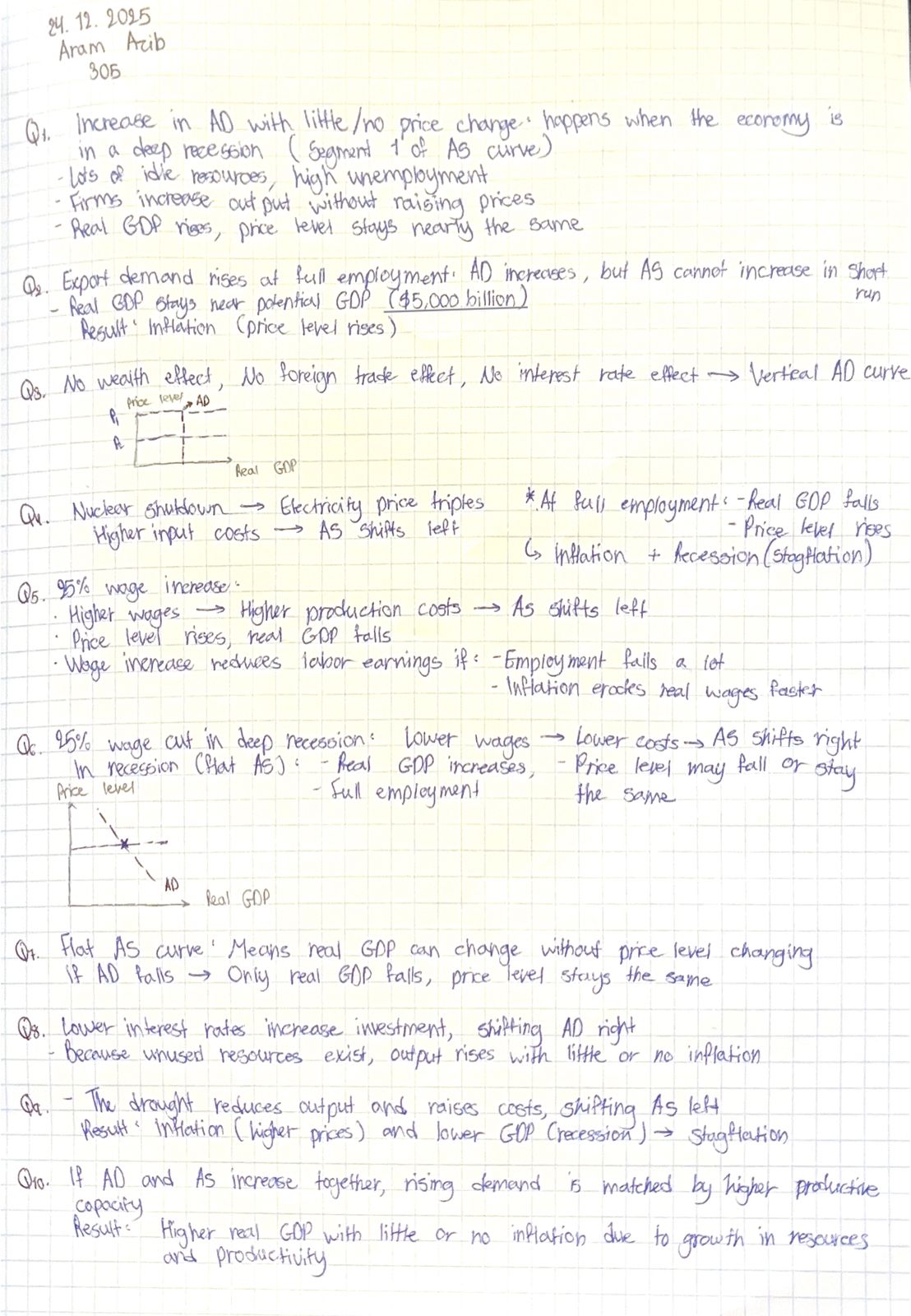
1) Increase in Aggregate Demand with Little/No Price Effect
This would occur if the economy is operating with significant spare capacity, meaning it is in a deep recession or far below potential GDP. In this region, the Aggregate Supply (AS) curve is very flat (Keynesian range). An increase in Aggregate Demand (AD) primarily increases real GDP by putting idle resources (labor, capital) to work, with minimal upward pressure on wages and prices.
2) Sharp Increase in Export Demand
· Initial State: Equilibrium real GDP = Potential real GDP = $5,000 billion. The economy is at full employment.
· Shock: A sharp increase in exports increases AD.
· Forecast: At full employment, the AS curve is relatively steep (near-vertical in the classical range). The increase in AD will create an inflationary gap (equilibrium GDP > potential GDP). Firms try to increase output but run into capacity constraints, bidding up wages and prices. The primary result will be inflation, with only a temporary, small increase in real GDP above potential.
· Answer: Higher inflation.
3) Aggregate Demand Curve with Indexed Assets & No Trade
The described economy has no wealth effect (assets adjust for price level changes), no interest rate effect (real interest rates are fixed), and no net export effect (no international trade).
· Result: There is no reason for the quantity of real GDP demanded to change when the price level changes. Consumption, investment, and net exports would be insensitive to the price level.
· Shape: The AD curve would be a vertical line at a given level of real GDP.
4) Shutdown of Nuclear Power Plants (Full Employment Start)
· Shock: A tripling of electricity prices represents a negative supply shock. It increases production costs economy-wide.
· Effect: The Aggregate Supply curve shifts leftward (or upward).
· Macroeconomic Equilibrium: At the initial AD, this leads to a higher price level (inflation) and a lower real GDP (recession). This is stagflation.
5) Government-Mandated 25% Wage Increase
· Shock: A large, exogenous increase in nominal wages is a negative supply shock. Production costs rise sharply.
· Effect: The Short-Run Aggregate Supply (SRAS) curve shifts leftward.
· Macroeconomic Equilibrium: Higher price level and lower real GDP (stagflation).
· When will it reduce labor earnings? If the resulting decrease in employment (hours worked) is proportionally larger than the 25% wage increase. This is likely if the wage hike prices workers out of the market, leading to significant layoffs. Total labor earnings = wage rate × employment. If employment falls by more than 25%, total earnings decline.
6) 25% Nominal Wage Cut in a Deep Recession
· Context: Deep recession implies the economy is on the flat portion of the AS curve, with high unemployment and idle capacity.
· Shock: A general wage cut reduces production costs.
· Effect: The SRAS curve shifts to the right (downward).
· Graphical Impact: On a graph with a flat SRAS, the rightward shift of SRAS along a given, downward-sloping AD curve leads to a significant increase in equilibrium real GDP with a very small decrease in the price level (or none). The economy moves out of recession.
7) Aggregate Supply as a Flat Line
· Implication: A perfectly flat AS curve implies the economy has massive spare capacity. Firms can increase output at the current price level without facing higher costs (constant marginal cost).
· Effect of a Decrease in AD: If AD decreases, real GDP will fall substantially, but the price level will not change. The entire adjustment is in output and employment, not prices. This depicts a severe recession with rigid prices (or a very short-run view).
8) Central Bank Lowers Rates in a Deep Recession
· Context: Deep recession = economy is on the flat portion of the SRAS curve.
· Mechanism: The Central Bank lowers real rates → increases Investment (I) → AD shifts rightward.
· Result: Because SRAS is flat, the increase in AD increases real GDP significantly with little or no increase in the price level. Idle resources are mobilized without creating inflationary pressure.
9) Severe Drought in an Agri-Dependent Nation
· Shock: A drought destroys agricultural output, a key resource. This directly reduces potential output and raises costs for food and related industries.
· Effect: This is a negative supply shock. The Long-Run and Short-Run Aggregate Supply curves both shift leftward.
· Macroeconomic Equilibrium: The new equilibrium features a higher price level (inflation) and a lower real GDP (recession) – classic stagflation.
· Why Both? The drought reduces the economy's productive capacity (causing recession). The scarcity of a fundamental good (food) drives up its price, which feeds into the general price level and forces consumers to spend more on basics, reducing demand for other goods.
10) Growth without Inflation: Increasing AD with Increasing AS
· Scenario: Both Aggregate Demand (AD) and Long-Run Aggregate Supply (LRAS, or potential GDP) are increasing over time.
· Analysis: For a growing economy, sustained, non-inflationary growth occurs when increases in AD are matched by increases in AS.
· Mechanism:
1. Growth in AS (LRAS shifts right): Driven by increases in the quantity/productivity of resources (more labor, more capital, better technology). This expands the economy's capacity to produce.
2. Growth in AD (AD shifts right): Driven by factors like rising consumer confidence, business investment, and government spending, which increase spending in the economy.
· Non-Inflationary Outcome: If the rightward shift in AD is approximately equal to the rightward shift in LRAS, the economy grows to a new, higher level of real GDP with little or no increase in the price level. The increased spending (AD) is fully absorbed by the increased productive capacity (AS). This is often depicted as the economy growing along a path of stable prices.
This would occur if the economy is operating with significant spare capacity, meaning it is in a deep recession or far below potential GDP. In this region, the Aggregate Supply (AS) curve is very flat (Keynesian range). An increase in Aggregate Demand (AD) primarily increases real GDP by putting idle resources (labor, capital) to work, with minimal upward pressure on wages and prices.
2) Sharp Increase in Export Demand
· Initial State: Equilibrium real GDP = Potential real GDP = $5,000 billion. The economy is at full employment.
· Shock: A sharp increase in exports increases AD.
· Forecast: At full employment, the AS curve is relatively steep (near-vertical in the classical range). The increase in AD will create an inflationary gap (equilibrium GDP > potential GDP). Firms try to increase output but run into capacity constraints, bidding up wages and prices. The primary result will be inflation, with only a temporary, small increase in real GDP above potential.
· Answer: Higher inflation.
3) Aggregate Demand Curve with Indexed Assets & No Trade
The described economy has no wealth effect (assets adjust for price level changes), no interest rate effect (real interest rates are fixed), and no net export effect (no international trade).
· Result: There is no reason for the quantity of real GDP demanded to change when the price level changes. Consumption, investment, and net exports would be insensitive to the price level.
· Shape: The AD curve would be a vertical line at a given level of real GDP.
4) Shutdown of Nuclear Power Plants (Full Employment Start)
· Shock: A tripling of electricity prices represents a negative supply shock. It increases production costs economy-wide.
· Effect: The Aggregate Supply curve shifts leftward (or upward).
· Macroeconomic Equilibrium: At the initial AD, this leads to a higher price level (inflation) and a lower real GDP (recession). This is stagflation.
5) Government-Mandated 25% Wage Increase
· Shock: A large, exogenous increase in nominal wages is a negative supply shock. Production costs rise sharply.
· Effect: The Short-Run Aggregate Supply (SRAS) curve shifts leftward.
· Macroeconomic Equilibrium: Higher price level and lower real GDP (stagflation).
· When will it reduce labor earnings? If the resulting decrease in employment (hours worked) is proportionally larger than the 25% wage increase. This is likely if the wage hike prices workers out of the market, leading to significant layoffs. Total labor earnings = wage rate × employment. If employment falls by more than 25%, total earnings decline.
6) 25% Nominal Wage Cut in a Deep Recession
· Context: Deep recession implies the economy is on the flat portion of the AS curve, with high unemployment and idle capacity.
· Shock: A general wage cut reduces production costs.
· Effect: The SRAS curve shifts to the right (downward).
· Graphical Impact: On a graph with a flat SRAS, the rightward shift of SRAS along a given, downward-sloping AD curve leads to a significant increase in equilibrium real GDP with a very small decrease in the price level (or none). The economy moves out of recession.
7) Aggregate Supply as a Flat Line
· Implication: A perfectly flat AS curve implies the economy has massive spare capacity. Firms can increase output at the current price level without facing higher costs (constant marginal cost).
· Effect of a Decrease in AD: If AD decreases, real GDP will fall substantially, but the price level will not change. The entire adjustment is in output and employment, not prices. This depicts a severe recession with rigid prices (or a very short-run view).
8) Central Bank Lowers Rates in a Deep Recession
· Context: Deep recession = economy is on the flat portion of the SRAS curve.
· Mechanism: The Central Bank lowers real rates → increases Investment (I) → AD shifts rightward.
· Result: Because SRAS is flat, the increase in AD increases real GDP significantly with little or no increase in the price level. Idle resources are mobilized without creating inflationary pressure.
9) Severe Drought in an Agri-Dependent Nation
· Shock: A drought destroys agricultural output, a key resource. This directly reduces potential output and raises costs for food and related industries.
· Effect: This is a negative supply shock. The Long-Run and Short-Run Aggregate Supply curves both shift leftward.
· Macroeconomic Equilibrium: The new equilibrium features a higher price level (inflation) and a lower real GDP (recession) – classic stagflation.
· Why Both? The drought reduces the economy's productive capacity (causing recession). The scarcity of a fundamental good (food) drives up its price, which feeds into the general price level and forces consumers to spend more on basics, reducing demand for other goods.
10) Growth without Inflation: Increasing AD with Increasing AS
· Scenario: Both Aggregate Demand (AD) and Long-Run Aggregate Supply (LRAS, or potential GDP) are increasing over time.
· Analysis: For a growing economy, sustained, non-inflationary growth occurs when increases in AD are matched by increases in AS.
· Mechanism:
1. Growth in AS (LRAS shifts right): Driven by increases in the quantity/productivity of resources (more labor, more capital, better technology). This expands the economy's capacity to produce.
2. Growth in AD (AD shifts right): Driven by factors like rising consumer confidence, business investment, and government spending, which increase spending in the economy.
· Non-Inflationary Outcome: If the rightward shift in AD is approximately equal to the rightward shift in LRAS, the economy grows to a new, higher level of real GDP with little or no increase in the price level. The increased spending (AD) is fully absorbed by the increased productive capacity (AS). This is often depicted as the economy growing along a path of stable prices.
Re: Topic 24.12.2025
от Малик Албарадан -
До свидания
Re: Topic 24.12.2025
от Ахмед Мохамед Ахмед -
Здравствуйте
Re: Topic 24.12.2025
от Ахмед Мохамед Ахмед -
До свидания
Re: Topic 24.12.2025
от Пелинсу Кара -
Здравствуйте
Re: Topic 24.12.2025
от Анасс Эль Фатими -
1) An increase in aggregate demand raises real GDP with little or no inflation when the economy is operating below potential GDP and the short-run aggregate supply curve is relatively flat.
2) When equilibrium GDP equals potential GDP ($5,000 billion), an increase in exports shifts AD right and causes higher inflation, with little or no increase in real GDP.
3) If assets are inflation-indexed, there is no trade, and real interest rates do not change, the aggregate demand curve is vertical.
4) Shutting down nuclear plants raises energy costs, shifting SRAS left, resulting in higher prices and lower real GDP.
5) A 25% increase in nominal wages raises production costs, shifting SRAS left, causing inflation and lower real GDP. Labor earnings fall if prices rise more than wages or employment declines.
6) A 25% cut in nominal wages shifts SRAS right, increasing real GDP and lowering the price level, helping the economy recover from recession.
7) A flat aggregate supply curve implies real GDP is independent of the price level. A decrease in AD reduces GDP without changing prices.
8) Lower real interest rates increase investment, shifting AD right, raising real GDP with little inflation when the economy has excess capacity.
9) A severe drought shifts SRAS left, causing higher prices and lower real GDP (inflation and recession).
10) Aggregate demand can rise without inflation when aggregate supply also increases, due to growth in resources and productivity.