Class 13
Re: Topic 27.11.2024
Здравствуйте
Re: Topic 27.11.2024
Re: Topic 27.11.2024
Здравствуйте
Re: Topic 27.11.2024
от Эвалин Атиено Одеро -
Re: Topic 27.11.2024
от Мохамед Ефаат -
Re: Topic 27.11.2024
Здравствуйте
Re: Topic 27.11.2024
Здравствуйте
Re: Topic 27.11.2024
Re: Topic 27.11.2024
Re: Topic 27.11.2024
Re: Topic 27.11.2024
Re: Topic 27.11.2024
Aya Yasser Abdallah
Re: Topic 27.11.2024
Re: Topic 27.11.2024

Re: Topic 27.11.2024
от Emna Labbene -
Re: Topic 27.11.2024
здравствуйте
Re: Topic 27.11.2024
1 Market power
2 Barriers to entry
3 monopoly
4 substitute
5 price discrimination
6 oligopoly
7 monopolistic competition
8price leaders ship
Re: Topic 27.11.2024
Re: Topic 27.11.2024
от Emna Labbene -

Re: Topic 27.11.2024

Re: Topic 27.11.2024
Re: Topic 27.11.2024

Re: Topic 27.11.2024
Re: Topic 27.11.2024
Name mohamed ali G: 406
1_market bower
2_parriers to entry
3_monopoly
4_substitute
5_price discrimination
6_oligopoly
7_monopolistic competition
8_price leaders ship
Re: Topic 27.11.2024
Re: Topic 27.11.2024
Re: Topic 27.11.2024
Re: Topic 27.11.2024
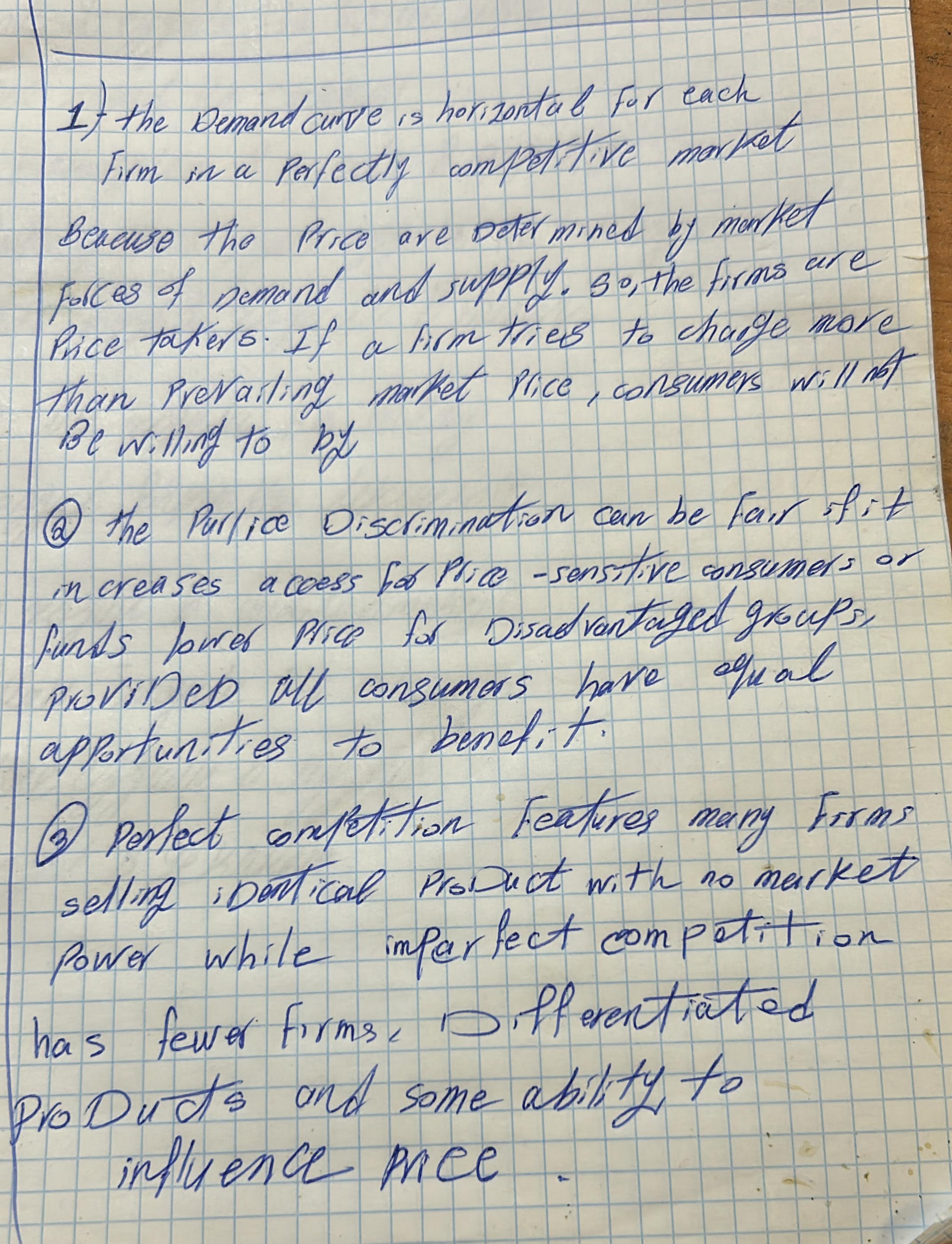
▎1. Why is the demand curve horizontal for a firm in a perfectly competitive market?
In a perfectly competitive market, the demand curve faced by an individual firm is horizontal (perfectly elastic) due to the following reasons:
• Homogeneous Products: All firms sell identical products. Therefore, consumers have no preference for one firm's product over another's.
• Price Takers: Firms are price takers; they cannot influence the market price of their product. Instead, they accept the market price determined by the overall supply and demand in the industry.
• Perfect Information: Consumers have complete information about prices and can easily switch to another firm if one raises its prices, leading to a loss of customers.
As a result, at the prevailing market price, a firm can sell any quantity of its product without affecting that price, leading to a horizontal demand curve at the market price level.
▎2. How can price discrimination be fair?
Price discrimination can be considered fair under certain conditions:
• Consumer Surplus: Price discrimination can increase overall consumer surplus by allowing different consumers to pay different prices based on their willingness to pay. Some consumers may benefit from lower prices, while those who are willing to pay more do so.
• Increased Access: It can improve access to goods and services for certain groups (e.g., students, seniors) who may not afford the standard price.
• Market Efficiency: Price discrimination can lead to more efficient allocation of resources. By charging different prices, firms can maximize their profits while still serving a broader range of consumers.
• Cost Justification: If the differing prices are based on differences in costs (e.g., delivery costs, bulk purchases), then it may be viewed as fair.
However, fairness is subjective and can vary depending on perspectives regarding equity and justice in pricing practices.
▎3. What is the difference between perfect competition and imperfect competition?
The main differences between perfect competition and imperfect competition include:
• Number of Firms:
• Perfect Competition: Many firms operate in the market, none of which can influence the market price.
• Imperfect Competition: Fewer firms exist, and they have some degree of market power, allowing them to influence prices.
• Product Differentiation:
• Perfect Competition: Products are homogeneous; consumers perceive no difference between products from different firms.
• Imperfect Competition: Products may be differentiated (e.g., through branding or quality), leading to consumer preferences.
• Barriers to Entry:
• Perfect Competition: No barriers to entry or exit exist; new firms can enter freely.
• Imperfect Competition: Barriers to entry may exist (e.g., high startup costs, regulations), making it difficult for new firms to enter the market.
• Market Power:
• Perfect Competition: Firms have no market power; they are price takers.
• Imperfect Competition: Firms have some degree of market power, allowing them to set prices above marginal cost.
• Efficiency:
• Perfect Competition: Leads to allocative and productive efficiency in the long run.
• Imperfect Competition: May lead to inefficiencies due to pricing above marginal costs and reduced output compared to perfect competition.
These distinctions help economists analyze market behavior and outcomes in different competitive environments.
Re: Topic 27.11.2024
Re: Topic 27.11.2024
Re: Topic 27.11.2024

Re: Topic 27.11.2024


Re: Topic 27.11.2024
Re: Topic 27.11.2024
Re: Topic 27.11.2024
Re: Topic 27.11.2024
До свидания
Re: Topic 27.11.2024
До свидания
Re: Topic 27.11.2024
Re: Topic 27.11.2024
Re: Topic 27.11.2024
До свидания
Re: Topic 27.11.2024
 IMG_4976.heic
Re: Topic 27.11.2024
от Мохамед Ефаат -
1-Market power
2-barraries to entery
3- monopoly
4-substitiut
5-price discrimination
6-oligopoly
7-monopolstic comptition
8-price leader s
Re: Topic 27.11.2024
Re: Topic 27.11.2024
Re: Topic 27.11.2024
от Эвалин Атиено Одеро -